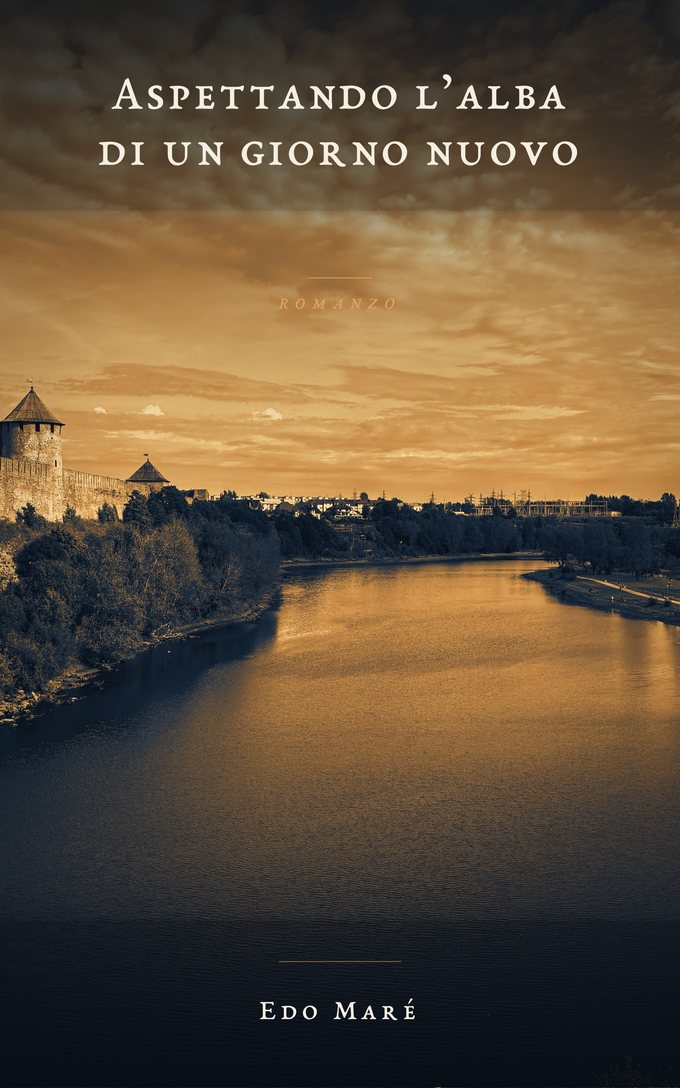
Novel · out now
Aspettando l'alba di un giorno nuovo
Waiting for the Dawn of a New Day · Italian-language edition
Two banks, a river, and a woman who learned as a child to count the exits of every room.
Waiting for the Dawn of a New Day · Italian-language edition
Two banks, a river, and a woman who learned as a child to count the exits of every room.
Narva, the last night of the year. On one bank of the river lies Europe; on the other, a few metres of water away, a world that watches it. Ania Sokolova grew up there, learning to count the exits of every room before she even sat down.
When love takes her to Barcelona — a man, a city by the sea, a new life stitched like a dress — she believes she has left the river behind. But some currents never loosen their grip, and the past of her father, an invisible man from a world that does not forgive, comes knocking just when everything seemed safe.
From the fortresses of the Baltic to the rooftops of Barcelona, a novel about what we are willing to betray to protect those we love — and about what it truly costs to wait for the dawn of a new day.
There was a way the river changed colour in the last minutes of the year.
I was born and educated in Italy; I live in Barcelona. And for work I have spent my life crossing borders: years in Germany, airports, tables with colleagues from every country. Borders, for me, are not an idea. They are my days. Understanding one another is never easy — and it is precisely there, in the effort of making ourselves understood, that I learned how many ways there are to live, and to be.
I travel often, but there is a river I return to now and then: the Narva, in the town of Narva, where one bank is Europe and the other Russia, and two fortresses have faced each other for five hundred years. I have seen it in winter turn to lead, and in summer, under the white nights, with flocks crossing it southwards without anyone asking them for a passport.
“Aspettando l'alba di un giorno nuovo” was born there, from the conviction that a border is only a bridge to be crossed. Seeing clearly the faces of the fishermen on either side of the river is the proof that there is space, air and water enough to live in harmony.